


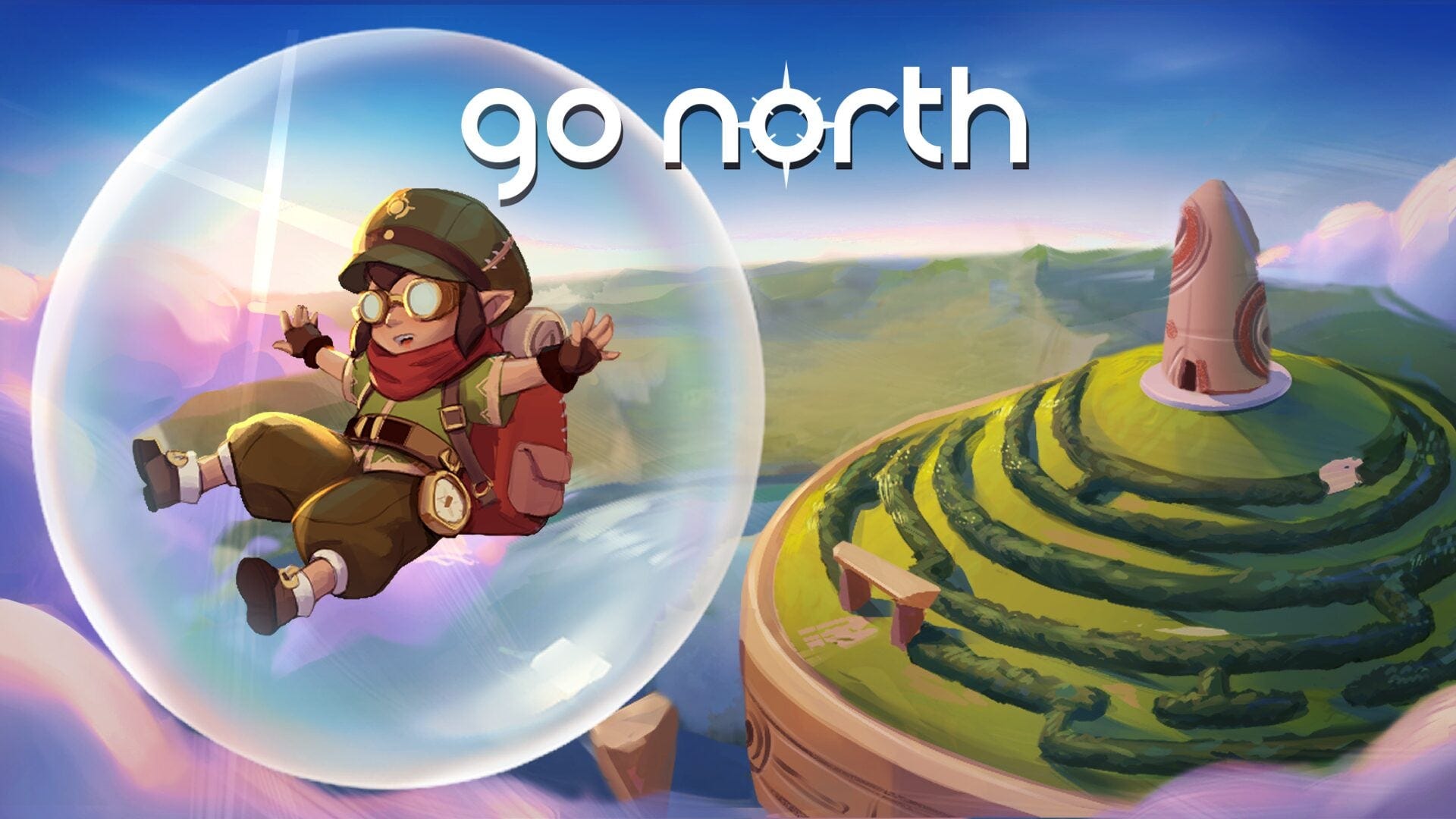
I wonder what an indie developer thinks about when they decide to publish a demo for a game with no release date and no plans for early access. If it’s not ready, why show it? To validate a concept? To get playtesting feedback? Eagerness to show the game? As it is, Go North’s demo requires a lot of polish, and additional playtesting isn’t needed to figure it out.
I thought my $250 gamepad suddenly had stick drift, with my character persistently moving forward without any input, and switching to keyboard didn’t help. The music noticeably stops before it restarts its loop. Commands disappear while you’re walking. Animations are floaty. The camera is uncomfortably close to the character’s back. There’s a hoverboard that emits a low-end hum that’s louder than most everything else. There are easy-to-spot grammatical errors. These are little details, but a demo is a first impression, no matter the intent behind showing it to the public. All of this can be improved, but no one had to see the game in this state.
In Go North, you are an explorer who wants to travel through increasingly difficult mazes to reach The Maze God (bleh). If you reach them, you’re granted one wish. The motivations are clear when Dara, the main character you control, tells her caretaker that she can’t let her die. It’s a sensible motivation, but it’s so bluntly stated that it almost takes all the stakes out of it. Its simplicity is no better than there’s a damsel in distress, so you must save her.
According to the description, something more sinister might be going on. I’d never know. Everyone is cheerful, everything is peaceful. Perhaps the terror strikes later in the game, and that’s when we see the stakes. It might even happen in the demo, but I couldn’t bear to find out.
Your goal is to navigate mazes to reach The Maze God. Why they’re there, we don’t know. Why is there a guy who jumps out of bushes and trees to give you new things? I don’t know. People simply exist, which is not abnormal for a game, but Go North wants me to build relationships, but all it does is give me shallow details about the citizens’ state of being, without contextualizing the world we exist in.
And it’s frustrating because it’s an interesting idea and world. I want to know more about it. Why does The Maze God give a wish? Why does it make you work for it? What happens if you don’t make it? All of these questions may matter, or none may matter, but there’s more plot needed at the beginning so that something matters.
While navigating the mazes, different obstacles block your path. You need to find the item that will help clear the way. It’s like a Metroidvania distilled down to its literal form. But it’s a game with a lot of unnecessary elements and is scared of its audience. As a cozy game, you can walk and run, but neither are too fast. But there’s an insanely fast hoverboard that turns the game into something more twitchy. There are plenty of clues on how to get through a maze, the most obvious being that the exit is always North. There are checkpoint statues that let you point them in a direction to remember where you are or where you want to go. You can also find maps that reveal the maze’s path. These tools help solve mazes faster, but they remove the adventure of getting lost while exploring.
Thank you for reading The Daily Demo! Did you play it? What’d you think of it? I’d love to hear your thoughts.