


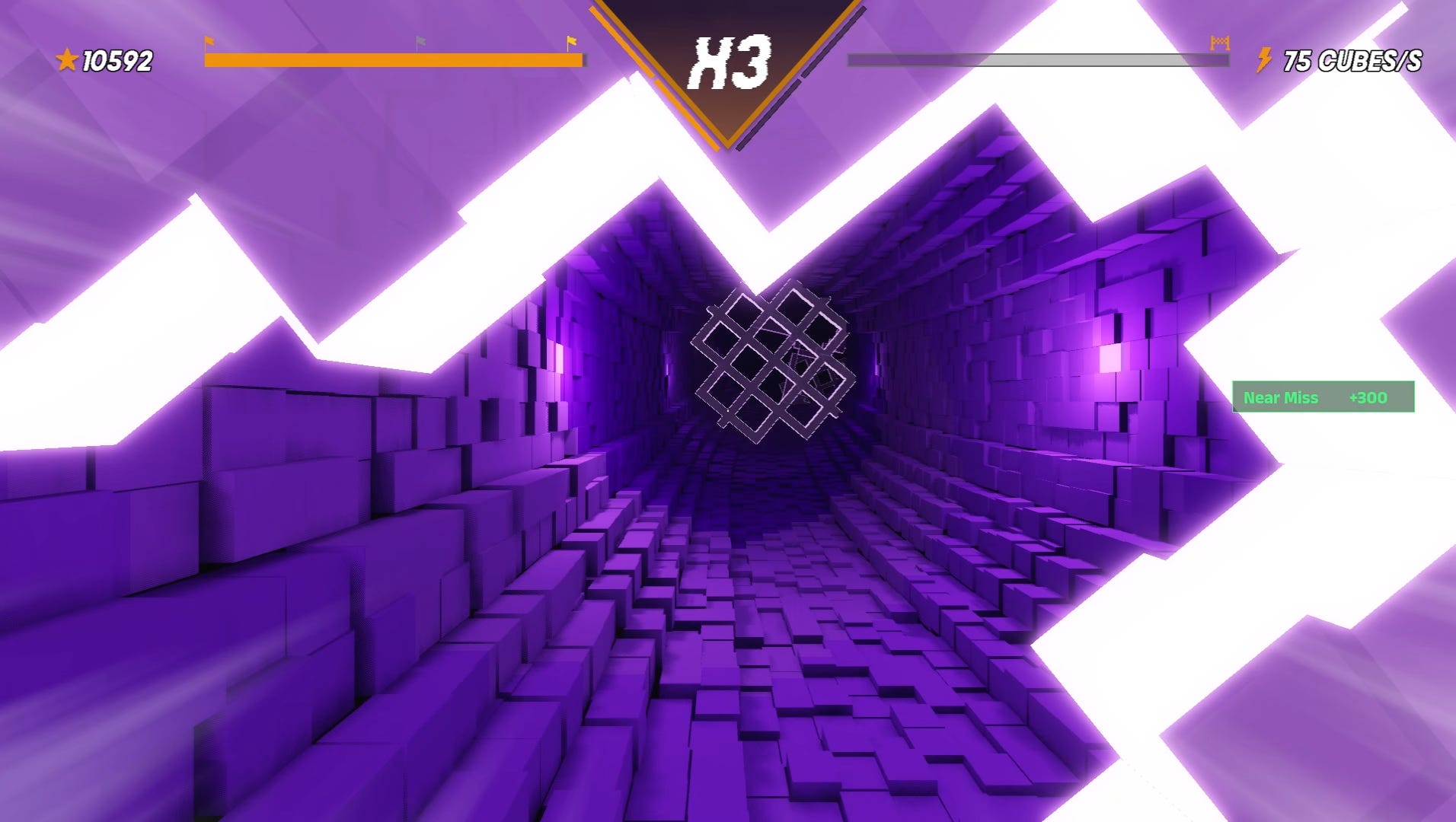
When a developer titles their game Sensory Overload, you might suspect it’s going to be a disgusting stew of mechanics that resemble a four-year-old playing science and just dumping every ingredient into the beaker expecting a delightful explosion. I’ve seen my fair share of games that have names that are exactly what the title says, and they have no kind of design sensibilities, hoping that it’s funny, or the developer finds it amusing, so everyone else must too. Sensory Overload is much smarter and measured. I didn’t want to stop playing. You alternate between states of consciousness and complete mental absorption. It’s less sensory overload and more hypnotic, though it certainly veers into excessive sensory input. It’s more about overburdening your eyes than overwhelming all your senses, but it certainly does what it says it will do. The goal is mastering your senses.
This is a game where all you do is avoid objects by moving through very tight spaces within a colorful tunnel. You need to get to the end, and if you hit something, you immediately start from the beginning. That’s it. It’s like you’re being sucked through a psychedelic vacuum and you need to survive to the end. The objects you move through vary in shape and rotation. As you play, the trance music fills you ears, you enter a flow state that’s really only interrupted by deaths or your wandering mind. And every time my mind wandered, it was like realizing I was driving a car while daydreaming and I’m suddenly jerked back into consciousness hoping I survive the objects flying at me. You would think something that feels so peaceful would require such intense focus, but the contrast works because you’re able to restart so quickly. It doesn’t feel good to be near the end (or even dying right at the end) and you have to overcome all those obstacles again, but that’s part of the challenge—overcoming yourself.
That’s Sensory Overload’s allure. Your mistakes are yours. It’s remarkable how you fly through small spaces sit feels like I’m in total control even though the game is in first-person. When I hit a wall, I know I hit it, and I saw it coming.
When it starts moving quickly through the tunnel, that’s when sensory overload. Maintaining that level of focus and reaction time might be for the young ones, as they’re able to absorb all the colors and speed better than I, but it’s still a delightful sense of tension that has a big release after finishing a level.
I am concerned about the colors and the physical effects it could have on people. I wouldn’t imagine epileptics could handle this game. To the developers credit, there is a photosensitivity slider that can adjust the intensity or eliminate the flashes. That’s another example of a developer who’s thinking about every element of their game. Sensory Overload looks like it will be a tight, focused game with one clear directive. That’s all it needs to be.