


No, this isn’t spam. I always start my titles with the game’s name, and “Thank You For Your Application” can absolutely come off as a trick for us newsletter writers. But it is I. This game, though, is actually called Thank You For Your Application. It truly reflects the worst of corporate life.
You are a robot living amongst other robots. Some robots are foreigners trying to earn legal status by getting a job, and to keep their citizenship by keeping the job. Many factors are created to make it hard to do. If you don’t pay your rent, you could be ‘exiled’—that’s how the game puts it. There’s a Minister of Mood who determines how mental health is handled; if your mental stability falls behind a certain threshold (monitored every day as you leave and enter your house), you might have to miss work, which would mean losing your job, which would mean getting deported. The premise accurately speaks to what’s happening in real life, while not saying anything about it during the game. It’s certainly doing more showing than telling.
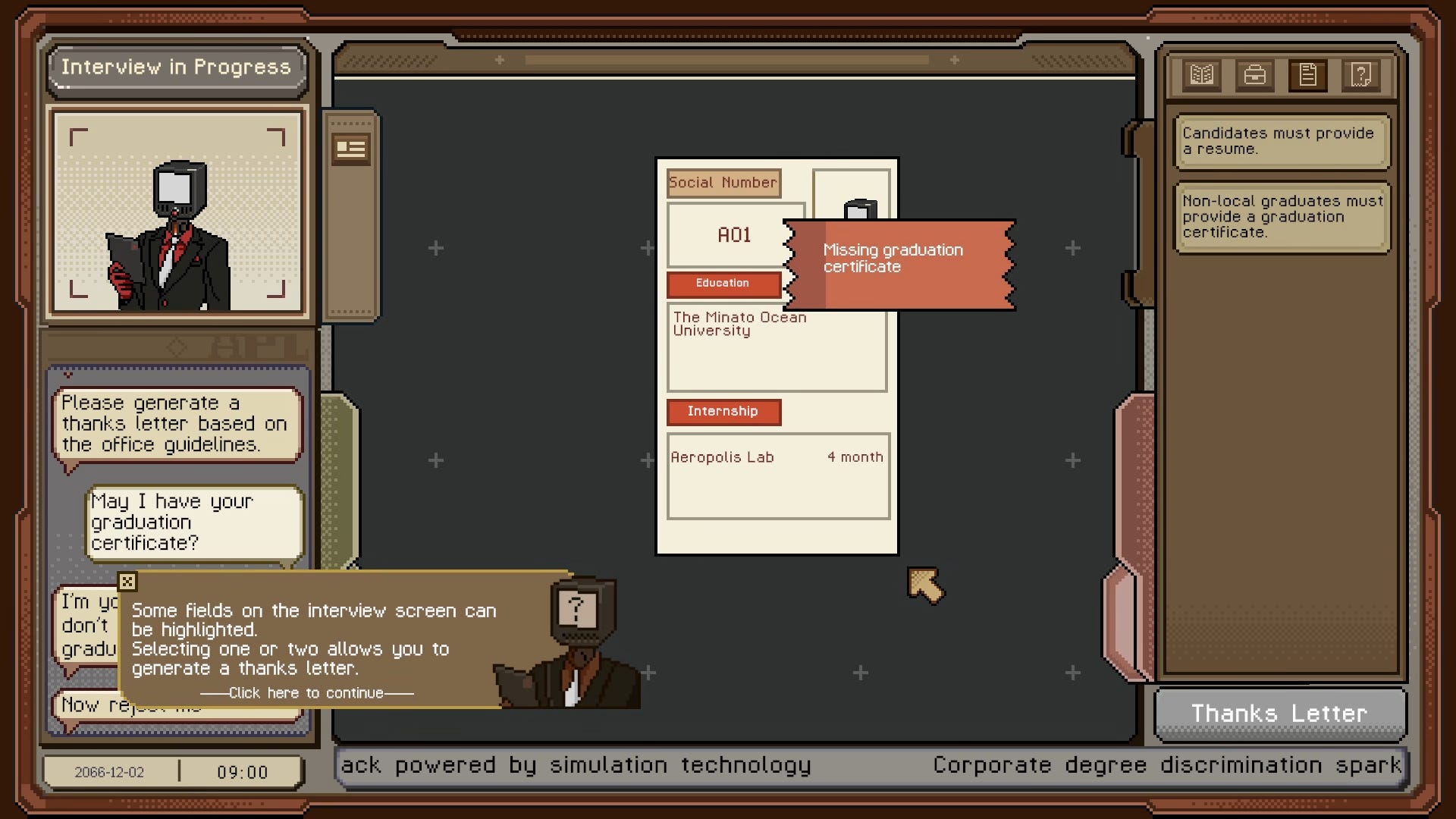
Your job is to sort through resumes. You are stage one 1 of 15 for prospective applicants. Each day, you’re given parameters that determine whether you move the candidate on to the next round or file them in the rejection pile.
What’s remarkable about Thank You For Your Application is how much it mirrors what I feel during and after work at some of my previous jobs. You clock in, do the work, get home, pay bills, read social media, check email, go to sleep, and do it all over again. It’s impressively monotonous. Even the color palette reminds me of boring, brown 90s offices. It’s so good at replicating the feel that it almost hurts the game. There are tensions when wondering if you’ll make enough money to pay rent, and sometimes you’ll read emails that include scams or family asking for money, but the inescapable doldrums are almost too on the nose. Considering this game is made by recent graduates, perhaps the reality they’ve recreated hasn’t quite hit them the same way it has me, an almost 40-year-old. Life is still exciting, so they can make something that feels like what they expect work to feel like. Well, they’re right, and I might not want to play more of it because it’s too good. So yes, well done, but make it a little more fun, but don’t change a thing. Fine criticism, indeed.
It’s still a challenging game of paying attention to an ever-growing number of details while moving fast. The more candidates you can accurately get through, the more money you earn. Make too many errors and you could lose your job. I don’t know if the game ends if that happens, but I suppose it works more like a roguelike if that’s the case. It’s hard to say with this demo.
I don’t know if it was a glitch, but there were times I couldn’t do what the game wanted me to do. For example, you have to provide a thank you letter with a reason for the rejection. You choose pre-made reasons that match why they’re being rejected. One reason is a graduation certificate. Some applicants didn’t have one, and I couldn’t figure out how to write a thank you letter for that reason.
Maybe it’s supposed to do that so you can’t have a perfect day. Maybe it’s because the instructions are as annoyingly written—business speak—so it’s intentionally hard to read. I don’t know. It doesn’t break the game, but the ambiguity of whether it’s my fault or the game certainly annoys me.