


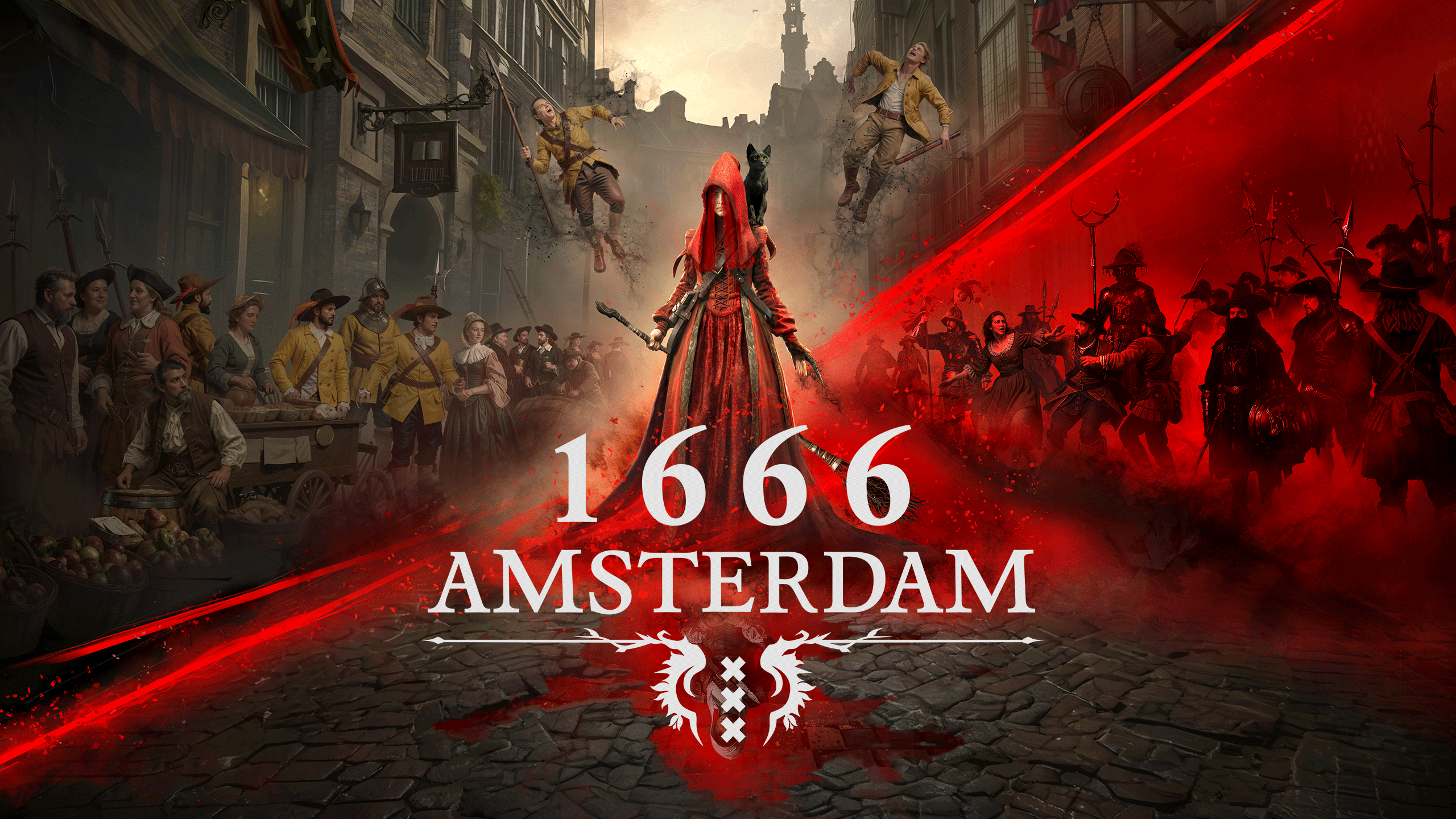
I’m shocked 1666 Amsterdam is able to get away with a 30 minute demo without any action. One swipe from a cat is all you get. I can appreciate the confidence. It’s well deserved.
The demo begins in a sepia-tinged forest, God-rays beaming through trees over the top of an animal corpse with cats chewing through its guts. You use the disgusting corpse to cast some kind of incantation to light candles. You’ll use this incantation more than once, and it’s seemingly to light something. It’s an unfulfilling spell. But those candles illuminate your path and, later in the demo, reveal more interesting and perplexing discoveries.
Down the path, you walk through credits. It’s a very engaging way to present those who have worked on the game. The way they hover on the screen is inescapable, and the way they float away, like leaves scattering in the wind, is graceful. The typography doesn’t fit thematically, but I know it’s a demo.
Once you reach the end of the path, you join your commencement ceremony—a group of Zaindaris in hooded dresses who are participating in what looks like a blood ritual. There’s another animal corpse with more cats eating its innards. You scurry them off, and they climb into a dry, leafless tree. You slice your hand and drop one spot of blood onto a small cube that turns into a twisted spherical concoction that conjoins to your hand and creates a long spike. If there weren’t enough Assassin’s Creed references, this is certainly the most obvious. But we don’t assassinate anyone with it, at least not in the demo.
Now, we choose a cat that will become our companion. I’m not sure what the cats do. They have names and descriptions, but their use isn’t mentioned or demonstrated in the prologue. I can imagine how frustrating it is to include something in a demo and have no way to assess its quality, but the developers want to tease, and the tease does its job. I’m left with more questions than answers.
The prologue purposefully obscures details because the end of the demo sets up the premise and its mystery, leaving us on a cliffhanger that’s memorable but not potent enough for us to keep it locked in our heads over an undetermined number of days.
Similarly to Assassin’s Creed, you bounce between the past and present. In the modern day, you follow a woman named Clio, who seems to come from the same lineage as the Zaindaris, the people wearing the hooded dresses. Clio is socially awkward, earnest, and seems to lack confidence. Her professor, a friend of her deceased father, has knowledge of the Zaindaris, but seemingly not enough to help Clio—or maybe he knows more than he lets on. We also meet Noa and Aaron, two modern day people—Clio’s parents—who seem to be having a referential Templar/Assassin relationship, assuming the Zaindaris are Templars, if we’re following Assassin’s Creed logic. I could be reading too much into it, but the parallels are inescapable.
I was confused by gameplay that felt inorganic—it felt like a video game. When you discover new items, they pop out and immediately drop to the floor. There’s a section you need to explore a library to find a book. When you find it, it magically appears and immediately drops to the floor. Other items you need to collect, like pulling something off a top shelf are handled the same way. I’d rather a prompt tell me I grabbed it. It doesn’t fit the universe. I imagine that can be worked out by launch, but it needs to be noted, in case it remains. It’s incongruous.
Another sequence you walking through a storied explanation of how Clio’s dad is no longer around. This is a letter to his daughter, but his description of details regarding him and his mom feel unrealistically specific. I have a daughter. When she’s old enough to knock boots, I still wouldn’t feel comfortable sharing about my hookups with her mother. “Agnes went directly to the bathroom ‘to put on her magic touch’, she said.” Yeah, Dad. Didn’t need to know that. The practical language feels out of place, but it is coming from someone who lived in modern times, not 1666. But the way we ebb from centuries in the past, to possibly decades in the past, makes it hard to keep up with the stylistic changes in speech. I don’t expect a millenial dad to speak like a 1600s person, but I suspect the tone to remain the same. Ezio spoke like an Italian of his time, but Desmond also spoke like a person of his time, and their tones matched—grounded, realistic. Clio’s dad sounds like a writer who’s trying to find what the right vibe is.
DLSS looks like it’s fighting to overtake faces in this demo. It’s most prominent during the scenes between Clio and the professor. The professor has an old, wrinkled, and freckled face, while Clio looks like she could be a woman in her 30s or a little older—or younger depending on what the DLSS is doing. Their faces constantly go from soft and feathered to sharp and detailed. Most of the time the technology is straddling the middle and it’s distracting. You’re helpless watching the characters have their conversation and their faces constantly shapeshift like a someone toggling a before and after test.
If this is what we have to look forward to with DLSS 5, it’s not welcome. I know it’s a demo, but this isn’t a good first impression of the technology.