


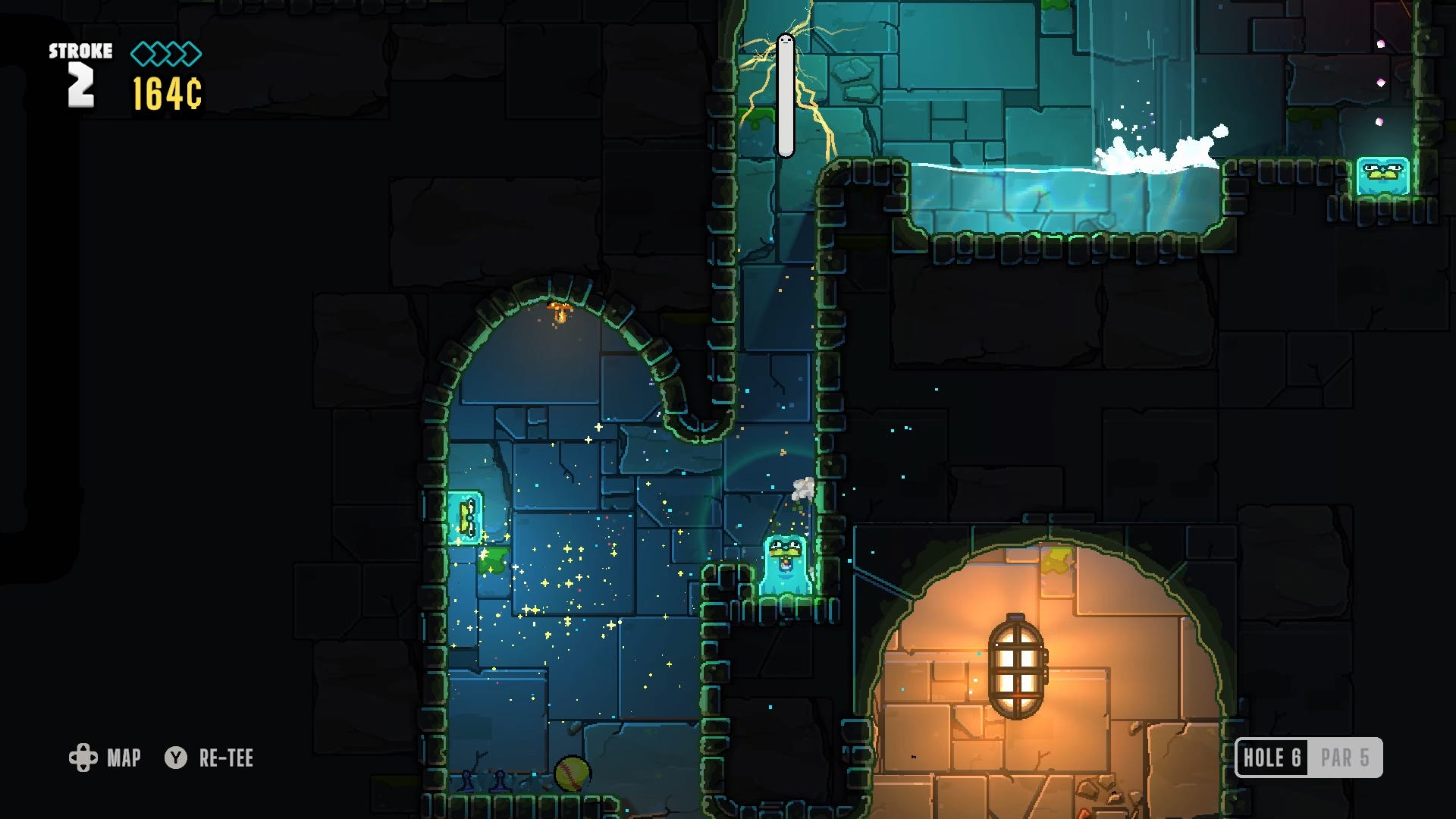
Golf, like any good sport, is very simple. Take a stick and smack a ball it into a hole in a little shots as possible. It’s why miniature golf is so fun. But it’s so simple and also a very, very slow game. It’s why miniature golf courses are filled with zany designs and feels like a carnival—it needs pizazz for the average person. Ballgame (which sounds more like a baseball game) takes the same approach as miniature golf—simple but adds zany courses. You navigate a level, that is physically designed like something out of Super Meat Boy, by smacking yourself across the level in as little shots as possible. The simplest ideas are the best ones.
You’ll have to figure out how to hit the ball in as little shots through water, ropes, and other objects strewn around even level. You’ll have to figure out how to hit the ball at angles, vertically, and around obstacles. It requires the same kind of concentration as a game of miniature golf, and it’s just as satisfying when you successfully drop the ball into the hole with few shots.
Blue Gems hang around the courses, and if you collect them they reduce your shot count at the end of a level, allowing you to score 0. It’s an intelligent way of adding Celeste-style-strawberry-collecting-complexity while adding benefits other than bragging rights.
Where I have concerns about Ballgame is what their desire to add more to an already solid game, and that there are already features in the game that feel like they’re there because that’s what games are supposed to do. My concern is portrayed as soon as the developers’ trailer plays on the Steam page. When it starts, why is the co-founder catching a red playground ball? I imagine it’s an attention-getter, but it’s a golf game. How does this fit? I know this has nothing to do with the game, but it’s indicative of the type of decisions the developer is willing to make.
Let’s get game specific: Why are there pennies you can collect throughout a course that would absolutely screw up the stroke count? The developer considers Ballgame a platformer. What do nearly all platformers have? Some kind of coin. Nintendo added the currency in Super Mario Bros. as a means of gaining lives and to incentivize exploration. Ballgame does it so you can earn customizations and upgrades. Why are there customizations to a ball that’s the smaller than a penny on screen? Are upgrades really necessary?
“Well, what’s wrong with currency and upgrades?” you might ask. Nothing in and of itself, except that it assumes you need it. It’s a good game without the extras. I wasn’t playing the demo thinking “This game really needs an upgrade mechanic.” But according to Video Game Development in the Day of Live Service Manual, it says “Players will leave your game if there is nothing to earn.” So, as it seems, there’s stuff to collect even though the game is absolutely fine without it.
The Video Game Development in the Day of Live Service Manual also says “Development must remain ongoing if you are to keep your playerbase.” Ballgame’s game description says “We have a ton of features and ideas for launch and beyond.” So the developer promises more features, and wants to hear yours, but it comes off as if they’ll be able to quickly iterate and features. They’re only setting themselves up for failure if that’s the case.
They’re absolutely allowed to develop this game however they want, but this is a skill-based game. Is mastery not enough to bring that audience back? Are they afraid people will master their ruthless levels quickly? Do they plan on selling these additions? I’m not sure what’s being communicated here. Perhaps these current features are there in case players get bored of the mastery part and want some other reason to flick the ball around. I can buy that. But that’s not the sense I’m getting from the demo and the product description.
I know some of this is meta video game analysis, but the business of games directly influences how games are made. Just look at what’s happening with Roblox and all the live-service games on the market. Games are expensive to make and players have wildly different expectations and misunderstandings of development. Ballgame should be good when it launches, but everyone, including the developer, should tread cautiously.