


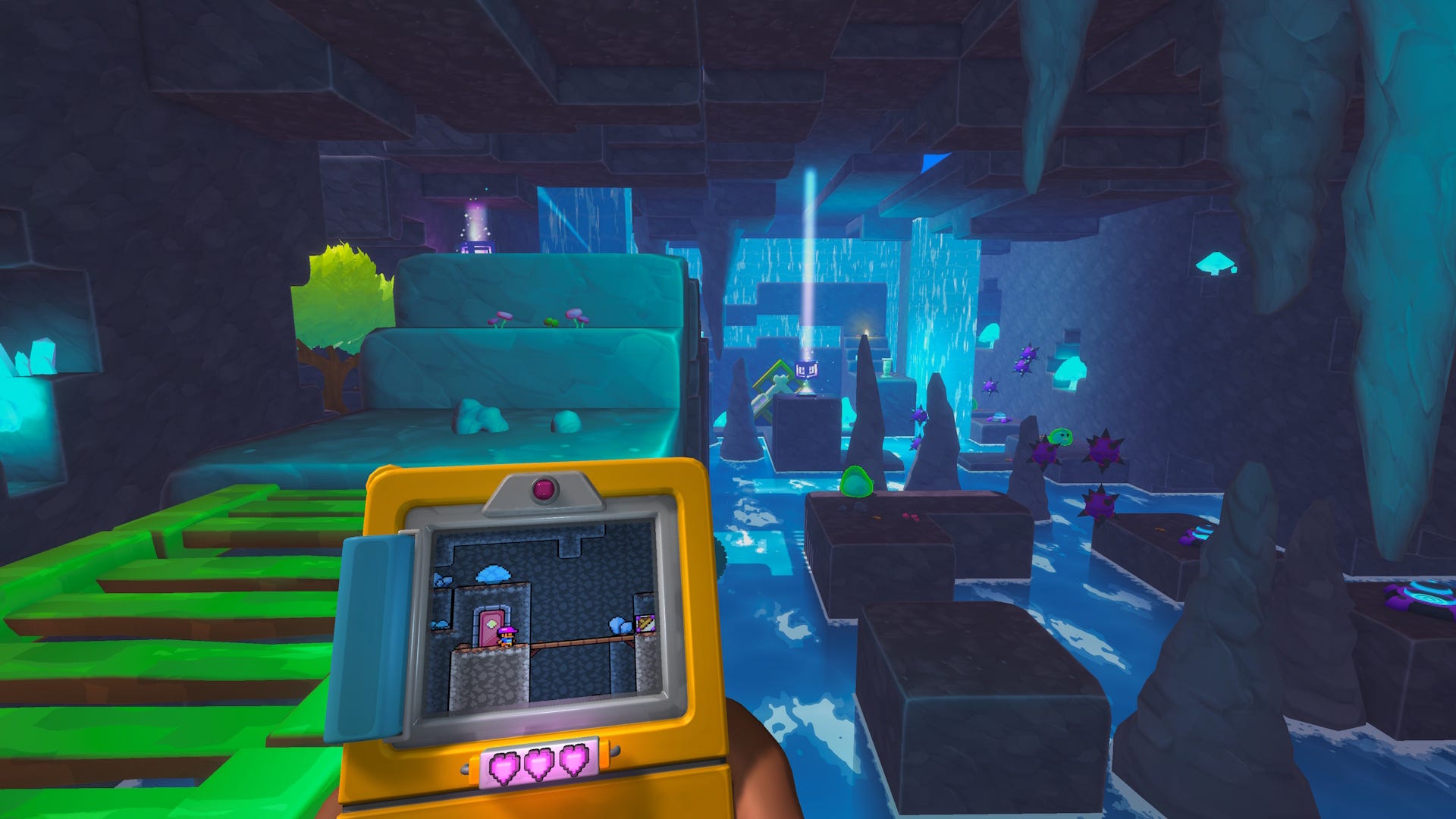
Imagine driving on a highway. You’re driving full speed. Plenty of cars are on the road. You’re bobbing and weaving between lanes, avoiding traffic. You’re doing this because there’s a giant monster chasing you. You can’t outrun this monster, you have to lob bombs at it to destroy it. But the twist is that you can only see the monster when you’re looking in the rear-view mirror. So you have to balance looking at what’s in front of you so you don’t crash, but look in the rear-view so you can see where you’re throwing the bombs. Sounds like a lot to manage, yeah? That’s what Screenbound feels like. The idea of playing a platformer where you’re in 3D, but also in 2D, is novel and refreshing. But it’s extremely frustrating.
You hold a giant Game Boy in your hand called a Q-Boy that renders your 3D world in 2D, but your 2D form still moves on different axis’s depicted by the background becoming more or less opaque. More opacity means you’re on the foreground, less means you’re somewhere in the background. Objects and items also phase through degrees of transparency and what’s full opaque can be collected, destroyed, or should be dodged.
Everything in the 3D world is fully rendered, except for what’s invisible. Anything invisible is shown in the 2D world on the handheld, unless you peer through the Q-Boy’s lens. This is how the game presents its challenge. In 2D or 3D, the platforming is simple, but withholding information in either dimension presents the challenge.
Control and precision is everything in a platformer, and Screenbound takes it away and repackages it as challenge. First-person platforming is already tough enough, but Screenbound forces you to do it with a giant block obscuring your landing zone. You can move the Q-Boy, but it’s not simple. You need to hold the option button and move the right stick down to move it from view—very difficult to do while you’re in the air, and it makes it impossible to move because you have to take your left thumb off the stick. Whatever side you move it to, it helps make it much more manageable until you have to do turns in midair, so it’s going to block something on the screen. Why have the Q-Boy in the middle at all?
Bounce pads launch you in the air, but your directional momentum continues after you touch it, so you’re constantly readjusting your landing position while you have this brick blocking your view. On top of that, sometimes you have to dodge invisible items in your path, which are only visible while looking down at the Q-Boy screen. I don’t know how the developer finds this design acceptable. There are enough platformers that feature bounce pads—Sonic being one of them— that suspend momentum and your ability to move, usually until you reach the apex of the jump. It makes landing manageable while still giving you a little wiggle room to mess up. I understand why the physics work that way. It aligns with the rest of the physics in the game. But it clashes with the level design. Platforming is about precision, and Screenbound sacrifices much needed precision to call itself challenging when it’s really incompatible design.
I got stuck on my demo run (featured in the video above) because I had to use a wind fan that would propel me into the air, catch a balloon that I could use to float to another platform, and dodge spike balls that were invisible in 3D. But some of the spike balls were off screen in 2D. So I would jump to catch the balloon and the spike ball would be in perfectly lined up to my body that I couldn’t avoid it, and I’d have to start from the beginning. There’s no way to know what the timing is.
What I would eventually realize in hindsight is that I should peer through my Q-Boy’s lens to potentially see the timing, but these off-screen shenanigans would continue while I’m in midair, and I have to look through the lens, which means sacrificing my 2D view, and manage where I’m landing in 3D. It’s absurd.
Classic 2D games like Kirby’s Dreamland 2 had characters that would suddenly appear from off-screen that made me lose health or die. The difference is, the developers were wise enough to know that would be unfair to have a character do that randomly, so it was always the same. First time, shame on the game. Second time, shame on me. In the case of Screenbound, it’s always shame on the game.
When you die, you start almost exactly where you left off. That’s good, but it’s no excuse for poor design. Just because death is inconsequential doesn’t mean you get to keep poor obstacle ideas. That’s unacceptable. Anyone should be able to get through a level without unnecessarily falling if they have the skill to do it.
A lot of standing and evaluating is required to play Screenbound correctly, which is the antithesis of a good platformer. Screenbound conditions you to take one jump, look down at your 2D screen to check for obstacles, move forward to a different platform, stop and check again, and repeat over and over. There’s no flow. I had moments where I’m jumping without a care and suddenly I crash into an invisible obstacle and fall. You’re right, I should have been looking at my screen, but at least when I look both ways before crossing the street, I don’t have to take a few steps and wonder if a car’s going to materialize like it’s Back to the Future. Platformers need flow. An entire game can’t be about second-guessing what’s a safe move.
I also wonder why there’s even a hearts system in the first place. You have three hearts. If you lose them all you respawn exactly where you left off as if you lost a heart. Coins respawn, but you don’t lose coin count. Why not just have no hearts? It doesn’t add to the challenge. It’s just another reason to be aggravated because you lost something you know you should keep. There are no stakes if we always respawn the same way. I’m not asking to make start completely over if we lose three hearts. Just get rid of them.
This game is about finding your classic damsel in distress. This time it’s your mom. Sorry, mom. I may have to leave you stranded.